

How Two Hours Daily Generates Real Income in 2026
Two hours of focused daily work is enough to generate meaningful income without sacrificing your grades or your sanity. The key is choosing high-return activities and following a structured workflow that compounds over time. Freelance writing, online tutoring, and digital product sales each pay far more per hour than a typical campus job. According to realistic income projections, early starters earn $100–$600 per month in year one and scale that figure 3–5 times by their senior year. Understanding how two hours daily generates student income is less about hustle and more about precision.
Which income activities yield the highest return in two hours?
The activities that pay the most per hour inside a two-hour window share one trait: output scales with skill, not with time logged. Online tutoring, freelance writing, and digital product sales all fit that description.
- Online tutoring pays $12–$22+ per hour on platforms that match you with students in your subject area. Two hours of tutoring sessions five days a week adds up to $120–$220 per week with zero commute.
- Freelance writing and content work generates $10–$50 per assignment depending on length and niche. A focused writer can complete one to two short assignments in two hours, making this one of the fastest ways to earn money as a young adult.
- Digital products such as study guides, templates, or short e-books require significant upfront effort but carry high margins and minimal ongoing labor. Once created, a single product can sell repeatedly with no additional time investment.
- Virtual assistance tasks like inbox management, scheduling, or social media posting pay $15–$25 per hour and are easy to fit into a fixed daily block.
The common thread across all four options is that they reward quality output, not hours clocked. A student who spends two hours writing a strong 1,000-word article earns more than one who spends four hours on low-value data entry.
Pro Tip: Pick one activity and commit to it for 30 days before adding a second. Spreading effort across three income streams in week one is the fastest way to earn nothing from any of them.

How does a two-hour daily workflow actually work?
Structure separates students who earn consistently from those who earn sporadically. The most effective two-hour daily workflow splits time between creation and distribution in roughly equal parts.
- Minutes 1–60: Create. Write the article, complete the tutoring session, finish the client deliverable, or build the next section of your digital product. This is the income-producing block. Guard it from interruptions.
- Minutes 61–90: Distribute and connect. Send pitches to new clients, post your work on relevant platforms, respond to inquiries, and follow up on pending proposals. Distribution is what turns a single piece of work into recurring income.
- Minutes 91–120: Plan with AI assistance. Use an AI writing or productivity tool to draft your next pitch, outline your next piece, or organize your task list for tomorrow. AI-assisted planning compresses 30 minutes of administrative work into 10, freeing more execution time.
This structure is not theoretical. One documented case tracked a two-hour daily side hustle from $14 in month one to $312 by month six, with a six-month total of roughly $900. That growth came directly from consistent distribution work, not just better content.
Pro Tip: Time-block your two hours at the same time every day. Treating it like a class you cannot skip removes the daily decision of whether to show up.
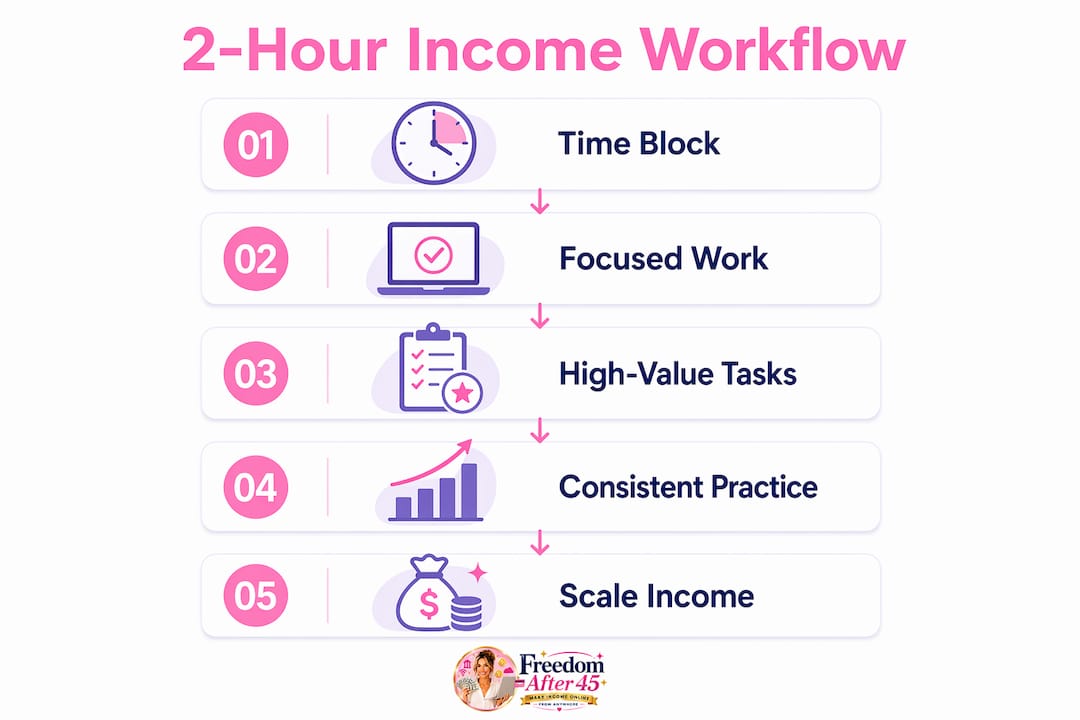
The biggest mistake inside a two-hour window is spending it on low-value tasks. Browsing job boards, tweaking your profile photo, and reorganizing your files feel productive but produce no income. Focusing 60–90 minutes on direct income-producing work consistently outperforms longer, unfocused sessions.
What happens to income when you start early and stay consistent?
Starting in year one of college is the single highest-leverage decision a young adult can make about income. The reason is compounding: skills, reputation, and client relationships all grow faster when they have more time to develop.
The income progression for students who start early and stay consistent follows a clear pattern:
| Year | Typical Monthly Income (US) | What drives the increase |
|---|---|---|
| Year 1 | $80–$300 | Building skills and first clients |
| Year 2 | $200–$700 | Repeat clients, faster output |
| Year 3 | $400–$1,500 | Portfolio credibility, higher rates |
| Year 4 | $700–$3,000 | Established reputation, referrals |
These figures come from tracked income data for students who committed to consistent two-hour daily work from year one. The 3–5x income increase from year one to year four is not accidental. It reflects the compounding effect of a growing portfolio and a network of clients who refer new work.
Waiting until junior year to start costs more than most students realize. A student who begins in year one and earns $200 per month in that first year will have built a client base and a portfolio that makes $700 per month in year four feel natural. A student who starts in year three begins that same climb with only two years left to benefit from it.
The practical implication is direct: start with whatever skill you have now, even if your first assignments pay less than you want. The rate you charge in year four depends on the work you do in year one.
How should you balance earning with academic responsibilities?
Earning money in two hours a day only works long-term if it does not wreck your grades or your health. The most effective approach treats academic cycles as the primary scheduling constraint.
- Front-load income work during lighter weeks. Early in a semester, before major assignments pile up, you can push your daily income block to two and a half or three hours. Bank that extra output for slower weeks ahead.
- Scale back during finals. Academic cycle planning prevents burnout and protects grades. Reducing your income work to 45 minutes during finals week is not failure. It is smart scheduling.
- Know your regulatory limits. International students on an F-1 visa face a 20-hour weekly work cap during the academic year. Exceeding it risks visa status. Domestic students need to track income against financial aid thresholds, since off-campus earnings above certain levels can reduce aid eligibility.
- Understand Federal Work-Study rules. The median work-study award is $1,790 per year at a median hourly wage of $13.62. Work-study earnings are exempt from FAFSA aid calculations, but off-campus freelance income is not. Knowing the difference protects your aid package.
- Track income as a math equation. Earning potential, academic obligations, and regulatory limits all interact. A student who earns $800 per month from freelance work but loses $600 in aid has gained only $200 net. Plan accordingly.
The students who sustain income across all four years are the ones who treat their schedule as a resource to protect, not just a problem to manage.
Key Takeaways
Two hours of daily, structured work in high-return activities compounds into meaningful income across the college years, with year-four earnings reaching 3–5 times year-one levels.
| Point | Details |
|---|---|
| Start in year one | Early starters compound skills and reputation, reaching $700–$3,000/month by senior year. |
| Choose high-return activities | Tutoring, freelance writing, and digital products pay far more per hour than campus jobs. |
| Split creation and distribution | Dedicate one hour to output and one hour to pitching and client outreach every day. |
| Plan around academic cycles | Scale up during light weeks and pull back during finals to protect grades and avoid burnout. |
| Know your income limits | F-1 visa caps, FAFSA thresholds, and work-study rules all affect your net earnings. |
What two years of watching this model taught me
The two-hour daily model works for one reason most people overlook: it removes the option of doing more. When you only have two hours, you cannot waste them. You are forced to identify the one or two tasks that actually produce income and do those first.
What I have seen consistently is that the students who struggle are not the ones with the least time. They are the ones who treat their income work like a hobby, picking it up when convenient and dropping it when life gets busy. The ones who build real income treat those two hours like a non-negotiable appointment.
The compounding effect is real, and it starts faster than most people expect. A young adult who earns $150 in month one and reinvests that time into better skills and stronger client relationships will not recognize their income by month twelve. The 2-Hour Workflow approach that Freedom After 45 teaches is built on exactly this principle: focused, repeatable daily effort beats sporadic bursts of motivation every time.
The other thing worth saying plainly: do not wait for the perfect skill or the perfect platform. Start with what you know, charge what the market will bear right now, and raise your rates as your portfolio grows. The cost of waiting is not zero. It is the compounding you give up.
— Freedom After 45
A proven daily workflow for building real income
Freedom After 45 built its reputation on one core idea: two focused hours a day, applied consistently, can generate daily profit without requiring a massive following or an existing product.

The 2-Hour Workflow program at earningdaily.net walks you through exactly how to structure those two hours for maximum return, which activities to prioritize, and how to scale your income as your skills grow. Thousands of people have used this blueprint to move from zero to consistent daily earnings. The framework applies whether you are starting from scratch or looking to make your existing side hustle pay more per hour. If you are ready to stop guessing and start earning with a clear daily plan, this is the place to begin.
FAQ
How much can you realistically earn in two hours a day?
In the first one to two months, realistic daily earnings from two hours of focused work range from $10–$30. By years three and four, consistent earners reach $50–$200 per day as skills and client relationships compound.
What is the best activity for earning money in two hours?
Online tutoring and freelance writing offer the fastest return for most young adults, paying $12–$50 per session or assignment with no startup cost and flexible scheduling.
Does starting early in college really make a difference?
Starting in year one produces income that is 3–5 times higher by senior year compared to starting in year three, because skills, portfolio credibility, and client referrals all compound over time.
Can international students earn income with this model?
Yes, but F-1 visa holders are limited to 20 hours of work per week during the academic year. Digital product sales and certain freelance arrangements may have different classifications, so checking with your international student office is the right first step.
Does freelance income affect financial aid?
Off-campus freelance income counts against FAFSA calculations above certain thresholds, while Federal Work-Study earnings do not. Tracking your income against your aid package each semester prevents unexpected reductions.