

How Students Start Earning Online Today in 2026
You don’t need a polished resume or a rare technical skill set to start generating income online as a student. Knowing how students start earning online today comes down to one thing: picking the right entry point for your current skills and schedule, then acting on it this week. The platforms, tools, and micro-opportunities available right now make it possible to see your first dollars within 48 hours. This guide covers the fastest paths, the smartest client strategies, and the financial basics every student earning online needs to know.
Table of Contents
- Key takeaways
- How students start earning online today: the fastest paths
- Finding your first clients through people you already know
- Balancing online work and your studies
- Beyond gig and freelance: more online income ideas for students
- Tax and financial basics for student earners
- My honest take on earning online as a student
- Ready to build a real online income system?
- FAQ
Key takeaways
| Point | Details |
|---|---|
| Start with what you already know | Use skills from your coursework to find paid work immediately, without waiting to learn something new. |
| Gig apps pay fastest | Platforms like DoorDash let you earn within 24-48 hours of signing up, making them ideal for quick cash. |
| Your network is your first client pool | Friends, professors, and campus organizations are the easiest and most reliable source of early clients. |
| Cap your hours during the semester | Limiting freelance work to 10-15 hours per week keeps your grades and your sanity intact. |
| Know your tax threshold | Self-employment income over $400 triggers a tax obligation, so track every dollar from day one. |
How students start earning online today: the fastest paths
The two most accessible routes are gig economy apps and freelance platforms. They work very differently, but both can put money in your account fast.
Gig economy apps like DoorDash, Uber Eats, and Instacart are built for speed. Gig apps let students earn within 24-48 hours of signing up, which is hard to beat if you need income this week. The flexibility is real too. Gig jobs allow students to skip shifts during exams without penalties, since there’s no manager to answer to.
Freelance platforms like Fiverr take a few more days to ramp up, but the income ceiling is much higher. The best part? You don’t need elite expertise. You only need to identify a solvable problem for your client. Can you write, edit, design a basic graphic, manage a spreadsheet, or run a social media account? Those are all marketable skills right now.
Here’s a side-by-side comparison so you can pick the right starting point:
| Factor | Gig apps | Freelance platforms |
|---|---|---|
| Time to first payment | 24-48 hours | 3-7 days |
| Required skills | Driving, physical availability | Writing, design, tech, marketing |
| Income ceiling | Moderate (hourly-based) | High (skill and scale-based) |
| Schedule flexibility | Very high | High (self-managed) |
| Long-term growth | Limited | Strong |
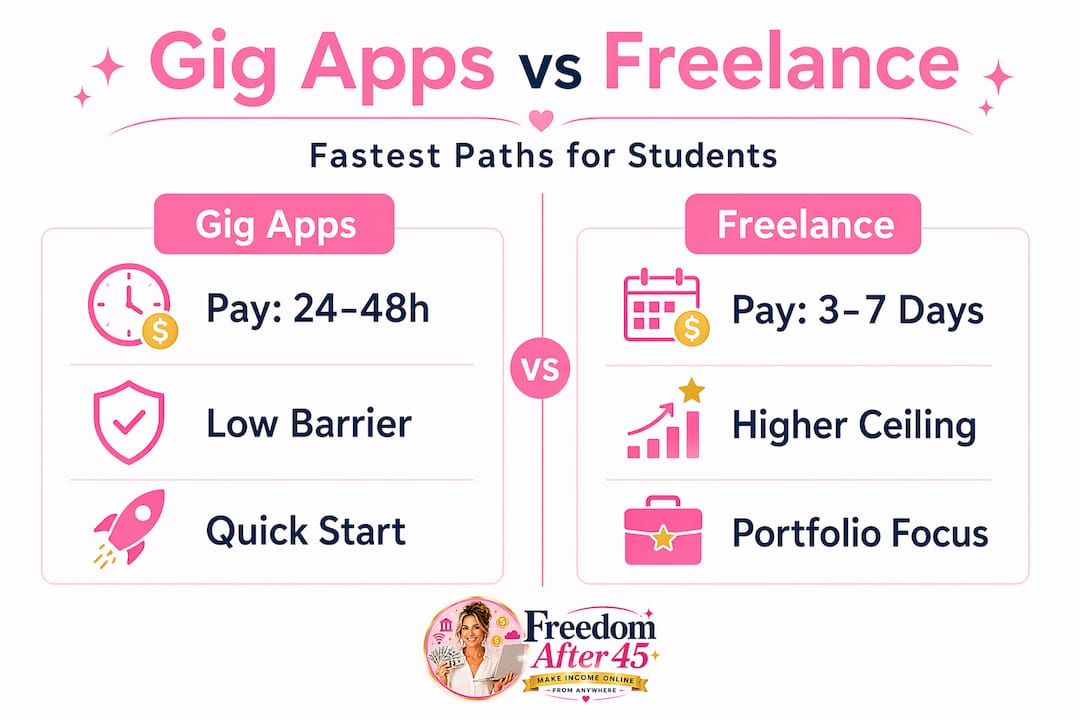
The decision is straightforward. If you need money this week and have a car, start with a gig app. If you have a marketable skill and a few days to set up a profile, freelancing builds far better long-term income.
Pro Tip: Don’t choose one and completely ignore the other. Many students run a Fiverr profile while using gig apps for reliable weekly cash during slower client periods.
Finding your first clients through people you already know
Skipping straight to online platforms is the single most common mistake new student freelancers make. The crowded marketplace on Fiverr or Upwork is brutal for someone with zero reviews. Your warm network is not.

Most students’ first clients come from people they already know: friends, family, professors, or former employers. That’s not a coincidence. People hire those they trust, and you already have that trust built with the people around you.
Here’s a simple process to land your first two or three paying clients through your network:
- Write down 20 names. Include classmates, professors, relatives with businesses, campus organizations, and local small business owners you’ve interacted with.
- Identify a specific problem you can solve for each. Don’t offer “social media help.” Offer to write three Instagram captions per week for a local coffee shop that clearly doesn’t post consistently.
- Send a short, specific message. Two or three sentences. Mention what you noticed, what you can do about it, and what you’d charge for a one-month trial.
- Do the first project at a reduced rate in exchange for a testimonial and portfolio piece. This is not working for free. It’s buying credibility with a small discount.
- Document the results. Impact-focused portfolios built on before/after screenshots and measurable business improvements consistently outperform generic sample-based ones.
Once you have two or three small wins with real clients, moving to platforms like Fiverr becomes dramatically easier. You have proof of work. That proof converts browsers into buyers.
Pro Tip: Campus organizations are wildly underused. The student government association, club sports teams, and Greek organizations all need event graphics, email newsletters, or social content. These are warm, accessible clients right on campus.
Balancing online work and your studies
Here’s the uncomfortable reality: most students who burn out on freelancing don’t burn out because the work is too hard. They burn out because they took on too much too fast and let client work eat into study time.
The fix is simple but requires discipline. Cap freelance work at 10 solid hours per week during the semester. That number might feel conservative, but it accounts for client communication, revisions, and unexpected project creep. Pushing past 15 hours regularly will cost you academically.
Practical ways to protect your time:
- Block your availability on a calendar. Tell clients you’re available Tuesday and Thursday evenings and Sunday afternoons. Hard limits prevent scope creep.
- Underpromise on timelines. If you can deliver in three days, quote five. Consistent early delivery builds a reputation far faster than scrambling to meet aggressive deadlines.
- Use platform tools during exam periods. Turning on Fiverr’s vacation mode before finals prevents new orders from piling up while you’re studying.
- Treat your academic schedule as a non-negotiable client. You would not miss a deadline for a paying client. Apply that same standard to your coursework.
Pro Tip: Set a recurring Sunday check-in with yourself. Review your workload for the coming week, confirm you’re inside your hour cap, and flag any deadlines that might conflict. Fifteen minutes of planning prevents a week of chaos.
Beyond gig and freelance: more online income ideas for students
Once you’re comfortable with the basics, these avenues expand your options significantly. Each fits a different combination of skills, time, and income goals.
- Online tutoring: If you’re strong in any academic subject, this is one of the most reliable recurring income streams available to students. Tutoring 4-6 regular students can generate $600-$1,500 per month working fewer than 15 hours weekly. Platforms like Wyzant and Tutor.com connect you with paying students quickly.
- Social media management: Small local businesses desperately need consistent social content but rarely have time to create it. Offering a simple package (three posts per week, basic graphics, and monthly reporting) is a concrete, low-barrier entry point. This also builds a portfolio that translates directly to higher-paying digital marketing work later.
- Digital products and content creation: YouTube, affiliate marketing, and selling digital templates on platforms like Etsy take longer to generate income but scale without trading more time for money. Expect three to six months before meaningful revenue, but the upside is passive income that pays while you study.
- AI-assisted freelancing: Students who learn to use AI writing and design tools intelligently can accelerate output and income significantly. A task that took four hours now takes one. That difference compounds fast.
| Income avenue | Avg. monthly earning | Time to first income |
|---|---|---|
| Gig apps | $300-$800 | 1-2 days |
| Freelance writing/design | $400-$2,000+ | 1-2 weeks |
| Online tutoring | $600-$1,500 | 3-7 days |
| Social media management | $300-$1,200 | 1-3 weeks |
| Digital products | $0-$500+ (month 1-3), then scaling | 2-6 months |
Tax and financial basics for student earners
Money you earn online is taxable income. That surprises a lot of students who assume small amounts fly under the radar.
Here’s what you need to know in 2026:
- Self-employment tax applies if your net income exceeds $400. That threshold is lower than most people expect.
- If you’re claimed as a dependent by your parents, you must file a federal return if your self-employment income exceeds $450.
- Set aside 15-20% of every payment you receive in a separate savings account. That money is not yours to spend. It covers self-employment taxes and prevents a painful surprise in April.
- Keep a simple income log in a spreadsheet. Record every payment, the date, the client, and the service provided. This takes two minutes per transaction and saves hours at tax time.
- Professional invoicing tools like Wave or PayPal Invoicing help you look credible, track payments, and request 50% upfront on larger projects. That upfront deposit protects you from non-paying clients.
Starting a Roth IRA the moment you have earned income is worth a quick mention. Contributions are made with after-tax dollars, grow tax-free, and can be withdrawn tax-free in retirement. Even $50 a month in your early 20s compounds into significant wealth. It’s not urgent, but it’s a smart early habit.
My honest take on earning online as a student
I’ve watched hundreds of students overcomplicate this. They spend weeks researching the “perfect” platform, building a website nobody asked for, and waiting to feel ready. Here’s what I’ve learned: the students who actually make money start before they feel ready and treat reliability as their competitive advantage.
You don’t need to be the best writer, designer, or marketer in the room. You need to show up, deliver on time, and communicate clearly when something goes sideways. Most freelancers do none of those things consistently. You will stand out just by doing all three.
The other hard truth I’ve learned? Workload boundaries aren’t optional. I’ve seen students wreck their GPA chasing a few hundred extra dollars, which undermines the entire reason they’re in school. Set your hours. Keep them. Start with a 60-day experiment: pick one method, commit to it, and measure results. Then adjust. That’s it.
Starting small and local beats chasing a massive online audience every single time in the early stage. The anchor client who gives you steady, predictable work is worth three volatile platform clients.
— Freedom After 45
Ready to build a real online income system?
If you’re serious about turning student-level online work into consistent daily income, the framework matters as much as the effort you put in.

Freedom After 45 offers a 2-Hour Workflow blueprint designed specifically for people who want to generate $100 to $1,400 daily without needing a social media following, existing products, or complex tech skills. The step-by-step program walks you through exactly how to set up a profit-generating system in just two hours a day. Thousands of people have already used it to move from financial stress to real flexibility. If you’re a student looking to accelerate your online income beyond side-hustle-level earnings, this is a practical next step worth exploring.
FAQ
How fast can a student start earning money online?
With gig apps like DoorDash, students can start earning within 24-48 hours of signing up. Freelance platforms like Fiverr typically take a few days to get the first order.
Do students need special skills to freelance online?
No. You only need to identify a problem a client has and offer a practical solution. Skills from coursework like writing, research, or basic design are enough to start.
How many hours per week should a student work online?
Capping freelance or gig work at 10-15 hours per week during the semester is the most sustainable approach. More than that risks academic performance and burnout.
Does a student have to pay taxes on online income?
Yes. Self-employment tax applies once net income exceeds $400. Students claimed as dependents must file a federal return if self-employment income exceeds $450 in 2026.
What’s the best first step for a student with no clients and no portfolio?
Start with your existing network. Offer a reduced-rate project to a local business or campus organization, document the results with measurable outcomes, and use that as your first portfolio piece.