

How Small Daily Earnings Change Your Finances
Small daily earnings are defined as modest, recurring income or savings amounts that compound over time to produce measurable improvements in financial health and stability. A study tracking 324 U.S. workers found that modest income increases reduce financial stress as effectively as large, one-time bonuses. The penny-a-day savings method accumulates roughly $668 in a single year, proving that how small daily earnings change finances is less about the dollar amount and more about the consistency behind it. Freedom After 45 has built its entire 2-Hour Workflow on this principle, helping women over 45 generate daily income without needing a product, a following, or a large upfront investment.
How small daily earnings change finances: the core impact
The financial impact of small daily earnings shows up in two places: your stress levels and your savings balance. Research tracking nearly 3,000 observations across nine weeks confirmed that small financial changes deliver immediate stress relief comparable to receiving a large bonus. That finding flips the conventional wisdom that only big windfalls move the needle.
The daily income financial benefits go beyond the numbers on a bank statement. When you see your balance grow by even a small amount each day, your brain registers a “small win.” That feedback loop reduces anxiety and builds a sense of control that larger, less frequent deposits simply cannot replicate.
Structured saving methods make this concrete:
- The penny-a-day challenge adds one cent on day one, two cents on day two, and so on, accumulating about $668 by day 365.
- Saving a flat $27.39 per day reaches $10,000 within a year.
- Saving $10 per day for 30 days produces $300 plus interest, with the primary benefit being the behavioral shift, not the balance.
Each method proves the same point. The amount matters less than the daily repetition. Repetition builds identity, and identity drives lasting financial behavior.
Does income timing affect your financial decisions?
The timing of when you receive income predicts your financial decisions more reliably than the total amount you earn. Predictable pay timing leads to better choices and lower stress, even when two people earn identical annual salaries. Unpredictable income forces the brain into a scarcity mindset, which increases impulsive spending and short-term thinking.
Earned Wage Access (EWA) is the industry term for programs that let workers access wages they have already earned before their scheduled payday. EWA directly addresses the timing problem by giving workers daily or on-demand access to their pay. A survey of 1,200 employees in low-to-middle-income households found that EWA users apply flexible daily earnings access primarily to:
- Bills (48% of users)
- Groceries (42% of users)
- Unexpected expenses (38% of users)
The practical result is fewer late fees, less reliance on high-interest credit, and better cash flow management between pay cycles.
“Flexible earned wage access shifts pay perception from a monthly transaction to a strategic tool. Workers who control when they receive their earnings report higher financial wellbeing and lower stress than those locked into rigid pay schedules.”
The retention data reinforces this. 64% of workers say they are more likely to stay with an employer that offers EWA. That statistic shows how deeply income timing affects behavior, not just budgeting.
Practical daily saving methods and how they stack up
Choosing a daily saving method comes down to your income level, your tolerance for variability, and how much behavioral reinforcement you need. The table below compares three proven approaches.

| Method | Daily amount | Annual result | Best for |
|---|---|---|---|
| Penny-a-day challenge | $0.01 rising to $3.65 | ~$668 | Building the habit from scratch |
| Flat daily savings | $10 fixed | ~$3,650 + interest | Steady income earners |
| Aggressive daily savings | $27.39 fixed | $10,000 | Goal-focused savers |
The penny-a-day method works because the starting amount is psychologically trivial. Nobody feels the loss of one cent. By the time the daily amount grows to a few dollars, the habit is already locked in. The behavioral reward, not the dollar figure, is what makes it stick.
Saving $10 per day for 30 days produces $300 plus interest, but the major benefit is behavioral change, not the balance itself. People who complete a 30-day saving challenge report spending less impulsively in the weeks that follow. The challenge rewires how they relate to money.
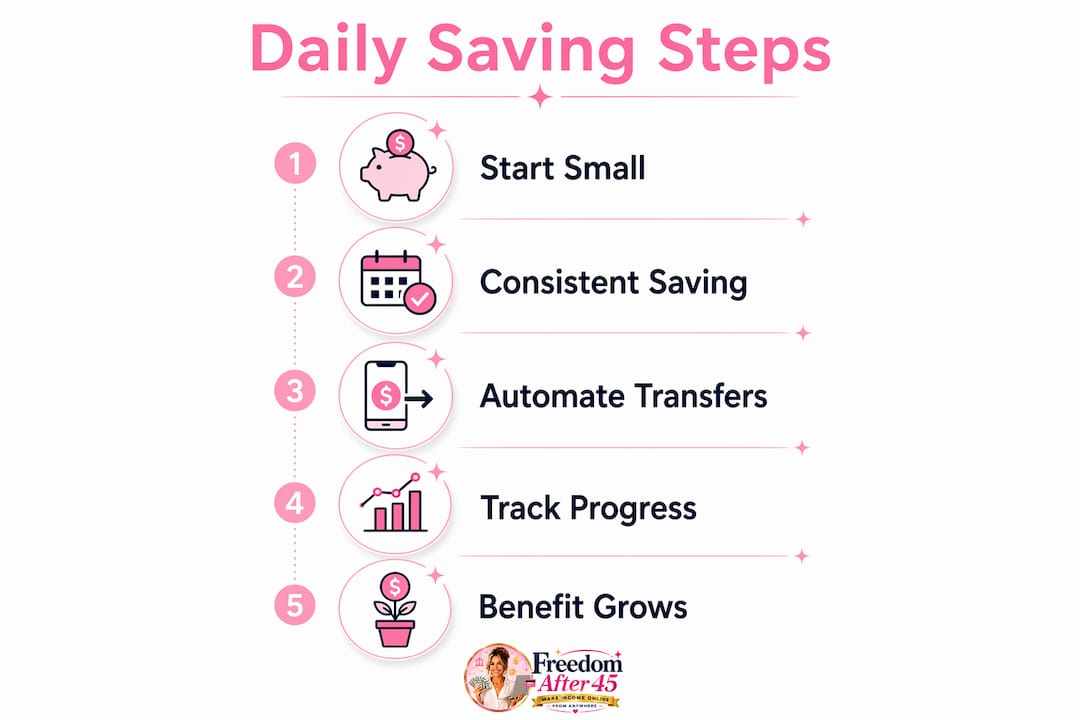
Pro Tip: Automate your daily transfer the moment your income hits your account. Automated saving systems eliminate decision fatigue by making the action non-negotiable. You never have to choose whether to save because the system already chose for you.
Why small daily habits rewire your financial behavior
Consistency beats intensity when it comes to financial habit formation. The 1% Rule states that improving your finances by 1% each day outperforms large, occasional financial actions that require unsustainable discipline. Small, daily improvements compound into identity shifts that large, sporadic efforts never produce.
The behavioral science behind this is straightforward:
- Reduced cognitive load. When saving is automatic and small, your brain does not treat it as a sacrifice. You spend less mental energy resisting the habit.
- Fewer impulsive purchases. Consistent small daily savings create a psychological boundary around discretionary spending. You start to see money differently.
- Positive identity reinforcement. Each completed day of saving confirms the belief “I am someone who manages money well.” That belief makes the next day easier.
- Momentum. Small wins build on each other. Missing one day feels like breaking a streak, which motivates you to restart quickly rather than abandon the habit entirely.
Pro Tip: Track your daily saving streak visually, whether on a paper calendar or a simple spreadsheet. Seeing an unbroken chain of checkmarks creates a powerful psychological incentive to keep going.
The key insight from behavioral finance is that the goal is not to save a specific amount. The goal is to become the kind of person who saves every day. The amount follows naturally from the identity.
How to apply daily earning and saving strategies right now
Applying these strategies does not require a financial advisor or a large income. It requires three specific decisions made once, then repeated automatically.
- Set a non-negotiable daily transfer. Choose an amount so small it feels almost meaningless, even $5 or $10. Schedule an automatic transfer from your checking account to a separate savings account every morning. The separation matters because money you cannot easily see is money you do not spend.
- Track one daily expense mindfully. Pick one spending category, coffee, subscriptions, or takeout, and log what you spend on it each day for two weeks. You do not need to cut it immediately. Awareness alone reduces spending in that category for most people.
- Use flexible income access when available. If your employer or income source offers any form of earned wage access or daily payout, use it to cover bills and groceries first. This prevents the cash flow gaps that force people onto credit cards and into debt cycles.
- Review weekly, not daily. Checking your balance every day creates anxiety. A weekly review gives you enough data to spot patterns without triggering the stress that comes from watching small fluctuations. Set a recurring 10-minute appointment every Sunday to review the week’s numbers.
- Increase the daily amount by $1 each month. Start at $5 per day in month one, $6 in month two, and so on. The increases are small enough to feel painless, but the compounding effect over 12 months is significant. This mirrors the penny-a-day logic at a higher starting point.
The change finances with side income principle works the same way. A small, consistent daily income stream, even $20 or $30, changes your financial psychology before it changes your balance. You stop thinking of yourself as someone who is always short on money. That shift is worth more than any single deposit.
Key Takeaways
Small daily earnings produce lasting financial change through consistency, behavioral reinforcement, and the compounding effect of habits built one day at a time.
| Point | Details |
|---|---|
| Stress relief is immediate | Modest daily income increases reduce financial stress as effectively as large bonuses, per a 324-person study. |
| Timing matters as much as amount | Predictable daily income leads to better financial decisions than unpredictable larger payments. |
| Small methods accumulate fast | The penny-a-day challenge builds $668 annually; saving $27.39 daily reaches $10,000 in a year. |
| Automation removes friction | Scheduling automatic daily transfers eliminates decision fatigue and locks in the saving habit. |
| Identity drives results | Consistent small wins shift your financial self-image, which sustains the habit long after motivation fades. |
What I have learned from watching daily habits change everything
Most financial advice focuses on the big moves: max out your 401(k), pay off debt aggressively, invest in index funds. That advice is not wrong. It is just incomplete for someone who does not yet have the financial margin to make those moves.
What I have seen, working with women over 45 through Freedom After 45, is that the daily habit almost always comes first. The woman who commits to saving $10 a day for 90 days does not just have $900 more. She has a different relationship with money. She makes different choices at the grocery store. She thinks twice before a subscription auto-renews. She starts asking whether a purchase fits her plan, not just whether she can afford it.
The biggest pitfall I see is inconsistency driven by perfectionism. Someone misses a day, decides the streak is broken, and stops entirely. The fix is simple: treat a missed day as a data point, not a failure. The habit is not about a perfect record. It is about a direction.
Daily earnings work the same way. A small, predictable income stream, even one that feels insignificant at first, changes how you plan, how you spend, and how you think about what is possible. The amount grows. The confidence grows faster.
— Freedom After 45
Daily earnings and the 2-Hour Workflow
Understanding the financial impact of daily earnings is the first step. Knowing how to generate them consistently is the second.

Freedom After 45 built the 2-Hour Workflow specifically for women over 45 who want to earn daily income without needing a product, a social media following, or prior experience. The program teaches a step-by-step method for earning 100% profit online daily, with participants generating between $100 and $1,400 per day by committing just two hours. Thousands of families have already used this blueprint to build the kind of daily income that makes every strategy in this article work faster and with less financial stress.
FAQ
How much can small daily savings add up to in a year?
Saving just $27.39 per day accumulates $10,000 in a year. The penny-a-day challenge, which starts at one cent and increases by one cent daily, builds roughly $668 by day 365.
Does daily income reduce financial stress more than monthly pay?
Research confirms that predictable, frequent income reduces financial stress more effectively than larger, less predictable payments. Consistent daily earnings give the brain a reliable feedback loop that lowers anxiety.
What is Earned Wage Access and how does it help?
Earned Wage Access (EWA) lets workers access wages they have already earned before their scheduled payday. Users primarily apply it to bills, groceries, and unexpected expenses, which reduces reliance on high-interest credit.
Why does automating savings work better than manual transfers?
Automated saving eliminates decision fatigue by making the transfer non-negotiable. When saving happens automatically, you remove the daily choice of whether to save, which is the point where most people fall off track.
How does the 1% Rule apply to daily financial habits?
The 1% Rule holds that improving your finances by 1% each day outperforms large, occasional financial actions. Small, consistent improvements compound into identity shifts and lasting behavioral change that one-time efforts cannot sustain.