

Household Passive Income: What It Is and How to Start
Household passive income is defined as money earned from rental activities, investments, or businesses where you do not materially participate on a daily basis. The IRS classifies this type of income under IRC §469, separating it from wages and active business earnings. Financial planners recommend that households aim for 10–20% of total gross income from passive sources to build real financial resilience. For women over 45 who want stability beyond a single paycheck, understanding this income category is the first practical step toward lasting financial independence.
What is household passive income and what types exist?
Household passive income is money from rentals, dividends, royalties, interest, or businesses where your direct involvement is limited. Each type works differently, but all share one trait: the income continues even when you are not actively working.
Rental income
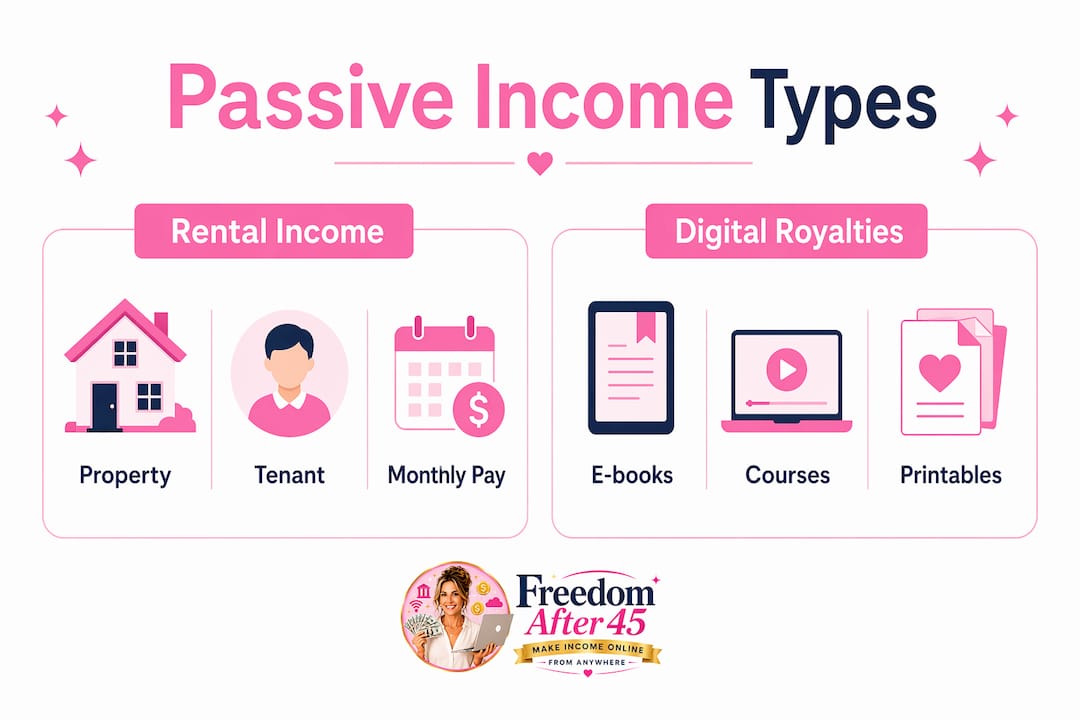
Rental income is the most widely recognized form. You own a property or spare room, and a tenant pays you monthly. The upfront work involves finding tenants, setting a fair price, and handling a lease agreement. After that, the income flows with relatively little daily effort, though property maintenance remains your responsibility.

Investment dividends and interest
Dividend-paying stocks, index funds, and bonds generate income based on capital you have already invested. You do not clock hours to earn the payment. The tradeoff is that you need existing savings or assets to begin. A $10,000 investment in a dividend fund paying 4% annually generates $400 per year without any additional labor.
Digital product royalties
Selling an e-book, a printable planner, or an online course generates royalties each time someone buys. The upfront work is real: you write, design, or record the content. After that, the product sells repeatedly. This is one of the most accessible options for women over 45 because it requires skills and knowledge rather than large capital.
Here is a quick comparison of the three main types:
| Income type | Upfront requirement | Ongoing effort | Barrier to entry |
|---|---|---|---|
| Rental income | Capital for property or spare room | Moderate (maintenance, tenants) | Medium to high |
| Investment dividends | Existing savings or assets | Low (portfolio monitoring) | Medium |
| Digital product royalties | Time and knowledge | Low to moderate (content updates) | Low |
Pro Tip: Start with the type that matches your current resources. If you have a spare room, rental income costs nothing extra to begin. If you have savings, a dividend fund is a natural fit.
What are the benefits and risks of household passive income?
The core benefit of passive income is financial diversification. A household earning $100,000 from a salary plus $10,000 from passive sources is more stable than one earning $110,000 from wages alone. The reason is simple: if the job disappears, the passive income keeps flowing.
Key benefits
- Supplemental cash flow that does not depend on hours worked
- Financial resilience during job loss, illness, or unexpected expenses
- Long-term wealth building through compounding dividends or appreciating assets
- Flexibility to reduce active work hours as passive income grows
Real risks you should not ignore
True passive income requires upfront investment of either time or capital. The “minimal effort” phase only begins after that initial work is done. Many people underestimate this and feel blindsided when the setup takes months.
Passive income is also often misunderstood as “set it and forget it.” Digital products need periodic updates. Rental properties need repairs. Investment portfolios need occasional rebalancing. Ignoring maintenance leads to declining returns.
Debt is the biggest risk for new earners. Financing passive income ventures with debt is a path that often ends in financial damage, especially for those in early financial stages. The rule is clear: use existing assets or skills, not borrowed money.
Pro Tip: Write down your current monthly expenses before choosing a passive income stream. This tells you exactly how much supplemental income you actually need, which keeps your expectations grounded.
How to start earning household passive income safely
The right starting point depends entirely on where you are financially right now. Ramsey Solutions outlines a practical framework: match your income stream to your financial phase. If you are still paying off debt, choose zero-cost options. If you have an emergency fund and savings, you can consider asset-based streams.
A step-by-step approach for beginners
- Assess your finances first. List your income, expenses, debts, and savings. This gives you a clear picture of what you can afford to invest in time or money.
- Choose a zero-cost option if you are in debt. Renting a spare room, selling unused items, or creating a simple digital guide costs nothing but time. These options generate cash flow without adding financial risk.
- Build your emergency fund before investing. Passive income from investments requires capital. Putting money into a dividend fund before you have three to six months of expenses saved is a risk you do not need to take.
- Pick one stream and commit to it. Spreading attention across five income ideas at once produces nothing. Choose the option that fits your current resources and work it through to completion.
- Reinvest early returns. The first $500 from a digital product or dividend payment is most powerful when reinvested. Compounding is what turns small passive income into meaningful household income over time.
- Review and adjust every quarter. Passive income is not static. A rental market shifts. A digital product becomes outdated. A quarterly review keeps your income streams healthy.
Freedom After 45 teaches this exact progression through its 2-Hour Workflow blueprint, which is designed specifically for women who want to build daily passive income without needing a social media following or existing product inventory.
Pro Tip: If you have professional knowledge from a career, a how-to guide or short online course is the fastest zero-cost passive income option available to you. Your expertise already exists. You just need to package it.
How does household passive income affect your taxes?
The IRS has specific rules about passive income, and misunderstanding them costs money. Under IRC §469, passive income comes from rental activities or businesses where you do not materially participate. Material participation means working more than 500 hours per year in that activity.
The 500-hour rule
If you work more than 500 hours in a business or rental activity, the IRS reclassifies that income as active. That changes your tax treatment entirely. Real estate professionals who log 750 or more hours in real estate activities can treat rental losses differently, which is a significant tax advantage.
Passive loss limitations
Tax loss deduction rules for passive activities limit how much loss you can deduct against your active income. If your rental property runs at a loss, you generally cannot use that loss to reduce your salary income dollar for dollar. Qualified real estate professionals are an exception to this rule.
Net Investment Income Tax
Passive income is often taxed differently than wages. Dividends, rental income, and royalties may be subject to the Net Investment Income Tax on top of regular income tax. Careful record-keeping avoids surprise tax bills at year end.
| IRS rule | What it means for you |
|---|---|
| IRC §469 passive classification | Income from rentals or businesses under 500 hours/year |
| Material participation threshold | Over 500 hours/year shifts income to active status |
| Passive loss limitation | Losses generally cannot offset active wage income |
| Real estate professional exception | 750+ hours allows better loss treatment |
| Net Investment Income Tax | May apply to dividends, royalties, and rental income |
Pro Tip: Track your hours in any rental or side business from day one. If you approach 500 hours, talk to a tax professional before year end. The classification change has real consequences.
Key Takeaways
Household passive income builds financial resilience by diversifying earnings beyond wages, but it requires upfront effort, realistic expectations, and smart tax planning to work.
| Point | Details |
|---|---|
| Definition and IRS classification | Passive income under IRC §469 comes from rentals or businesses with under 500 hours of participation per year. |
| Recommended income target | Households should aim for 10–20% of gross income from passive sources for financial stability. |
| Best starting point | Zero-cost options like renting a spare room or selling digital products suit those in debt payoff phases. |
| Biggest risk to avoid | Never finance passive income ventures with debt, especially during early financial stages. |
| Tax awareness is non-negotiable | Passive losses are limited, and the Net Investment Income Tax may apply to dividends and rental earnings. |
What I have learned about passive income after 45
Most financial advice about passive income is written for people in their 30s with decades of compounding ahead of them. That framing misses the point entirely for women over 45. The goal at this stage is not to build a 30-year portfolio. The goal is to create a reliable second income stream within the next 12 to 24 months.
The most common mistake I see is waiting for the “perfect” income stream before starting. Women spend months researching rental properties, dividend strategies, and digital products without committing to any of them. Meanwhile, a simple e-book or a rented spare room could have been generating income for six months already.
The second mistake is underestimating existing knowledge. A woman who spent 20 years in nursing, teaching, accounting, or any skilled field has expertise that other people will pay to access. That knowledge packaged into a guide, a course, or a consulting framework is passive income waiting to happen.
Starting small is not a compromise. It is the correct strategy. A $200 monthly passive income stream that you build in 60 days is worth more than a $2,000 plan that never launches. Build the habit and the confidence first. The income scales from there.
— Freedom After 45
Freedom After 45 and your next income step
Building household passive income is a skill, and like any skill, it is easier with a clear system.

Freedom After 45 offers a 2-Hour Workflow blueprint built specifically for women over 45 who want to generate daily income without a social media following, a product, or prior online experience. Thousands of families have already used it to create recurring income ranging from $100 to $1,400 per day. The program is step-by-step, beginner-friendly, and designed to get you earning as quickly as possible. If you are ready to put a real system behind your passive income goals, the 2-Hour Workflow is where to start.
FAQ
What is household passive income in simple terms?
Household passive income is money earned from rentals, investments, or digital products without working a traditional job for it. The IRS classifies it under IRC §469 as income from activities where you do not materially participate.
How much passive income should a household aim for?
Financial planners recommend that 10–20% of total gross household income come from passive sources. That level of diversification provides meaningful protection if active income is disrupted.
Do I need a lot of money to start earning passive income?
No. Zero-cost options like renting a spare room or selling a digital guide require no upfront capital. Experts specifically recommend these for anyone still paying off debt or building an emergency fund.
How is passive income taxed differently from wages?
Passive income may be subject to the Net Investment Income Tax and faces limits on loss deductions against active income. Tracking hours and income carefully from the start prevents unexpected tax bills.
What is the biggest mistake beginners make with passive income?
The most common mistake is financing passive income ventures with debt. Using borrowed money to fund a rental property or online business before you have financial stability dramatically increases your risk of loss.